We’ve all heard that line, or at the very least variations of it. “Google is Evil”.
I fully agree with this statement, in fact, I have evidence. No other company is as hellbent as they are to get their hands on your data, and sell it for profit. I mean, after all, they are an advertising company. It only makes sense for them to know you better than you can know yourself, so they can try and sell you things you didn’t think you needed. And that’s exactly the Problem I have with Google, the fact that they know oh-so-much about you. I find the idea creepy…and that’s being nice about it.
Picture this, for example.
Imagine going home after a long day of work. Wanting some time for yourself to truly unwind. As you arrive, you unlock the door, and lock it back up behind you. You are home. Your partner is still at work. You don’t have any kids. You have the entire kingdom for yourself. So you decide to get on your computer and play some games. Maybe a little session of Cyberpunk2077. During your session, an ad plays on one of the bulletin boards in the city center, advertising NiCola, a special brand of Cola that exists within the universe of this game. A beverage that resembles that of something you drink in real life quite often. You vocally say to yourself: “I could honestly go for some cola right now.”—And, as if someone was listening in on your conversation, the minute you look at your phone, to browse some articles to help finish some quest lines, you get a ton of ads for cola.
Dear reader, this is not a coincidence. This genuinely happens. Advertisement networks have all kinds of algorithms to help identify you as a person. Even if you actively disagree to cookies, and block trackers, there are a lot of ways advertisers can still track you. Merely having a presence is enough. If not a cookie, then a browser fingerprint. If not a fingerprint, your IP address. If not your IP address, your online habits, the way you talk, the type of content you follow, the system your computer runs on. All of this stuff is collected in a profile that determines YOU. And no, for the record, this is not me trying to fear-monger. This is just me having sober awareness. This just happens. And you cannot really escape it. And while some companies go through really extreme lengths to collect data they probably shouldn’t be allowed to get, I’ve mostly come to terms with it.
Offcourse, being the person that I am, I am not just gonna take it sitting down. I still have a right of privacy. And I still reserve every reason to be bothered by it. But some things are too big to be able to move. It is unfortunate, but it is what it is. And its better for people to accept that rather than tugging a dead horse. But that doesn’t mean there’s nothing to be done. You can still protect your privacy where you can. So I did.
What is De-Googling?
Wikipedia defines “De-Google” as a grassroots campaign that has spawned as privacy advocates urge users to stop using Google products entirely due to growing privacy concerns regarding the company.
As the growing market share of the internet giant creates monopolistic power for the company in digital spaces, increasing numbers of journalists and individuals have noted the difficulty to find alternatives to the company’s products.
Some projects, such as ungoogled-chromium, and MicroG primarily distinguish themselves from Google-maintained products by their lessened dependence on the company’s infrastructure.
It can be seen as part of a broader opposition to big tech companies, sometimes referred to as “techlash”.
People can decide to De-Google for any reason. But the most common one is control. There are lots of people out there that currently are entirely entwined in the google ecosystem. Their Email, Their Saved Passwords, Their Families’ Phone Numbers, Their Documents Stache, The Pictures of their children as they grew up. A lifetime of memories, apps, information…Basically everything you could probably care for and more, all in the hands of a company that, as I mentioned before, LOVES selling data for profit. People often say “Why are you so worried if you’ve got nothing to hide?”—I think the story changes a bit if you realize the grand scale of things. I do not want:
A) My Data just being Harvested from me as if I’m some kind of sheep to be shaved monthly.
B) To have to Trust the Same company that Milks me for Profit regularly with my most Personal memories.
C) To Deal with the Damage it causes to My Entire System if for whatever reason that one company I entrusted EVERYTHING to disappears.
No thanks, I would much rather deal with the overhead of handling everything myself. At least then, if something goes wrong, I have a sensible person to blame for it. Usually myself. Which, by the way, is how we learn. Making mistakes and recovering from it.
Why now?
To put it simply, I was putting it off due to a severe lack of understanding. The past year or so I’ve been delving into self-hosting stuff. Primarily with online services. Good examples of these would be the handful of Game Servers I operate for me and my friends. These served as an initial learning curve for self-hosting in general. This then later developed into me hosting my own Email Infrastructure, And now also, this here little blog. Through this, I’ve learned that I can in fact do things. Share things, and control things, all on my own accord. Which has also given me the courage to dive deeper into the rabbit-hole. I am learning more and more, the more things I try, and developing as an individual.
What have I already done?
Let’s start with an interesting one. It will make sense, trust me.
Windows is an operating system by Microsoft. A company also known for doing a lot of advertisement stuff. One could make the realistic assumption that Microsoft and Google are enemies of some kind. However, the opposite is actually true. While Microsoft and Google are Competitors in the Ad Space, they are also each other’s best costumers. They make money from each other.
Microsoft Windows 11, while a pretty decent looking operating system is plagued by Bloat, and it likes to phone home so much it sometimes forgets what its supposed to be doing. Talking to Daddy Microsoft so often puts a lot of strain on the underlying system, which is why some people have reported their systems slowing down under Windows 11. Windows 10 had the same issue, don’t be mistaken, but it was to a way lesser scale, especially in the earlier days of Windows 10. During Windows 10’s Lifespan, something changed, and the polished, clean system with non-distracting flat and honestly appealing design, started to become a bit of an advertisement machine. It started tracking the user more and more as time went on. And this continued well into the Windows 11 era. So much so in fact, that people are unironically noticing the performance loss. That old ThinkPad that used to run Minecraft at a pretty decent framerate? Yea good luck getting windows 11 to even boot on that. It is genuinely that bad.
This is an operating system I no longer can comfortably use. It is constantly meddling with stuff, interrupting my workflow, getting in the way. The infamous “Windows Update ruined my Gaming Session” Actually happened to me a couple times. Things slowed down so much I couldn’t keep up my work flows anymore. More often than not, I spent a whole second waiting for my *FILE MANAGER* to open up. The ***FILE MANAGER***…Ugh…I’m getting PTSD just thinking about it. I was already well aware of Linux at the time, and had already tried switching to it a few times. But every time before I was held back by some kind of dependency that only worked on Windows—something something Windows monopoly—topic for a different post…maybe. Anyway, That has changed. For over a year now, I have been able to run on Linux perfectly fine now. And it has actually improved my appreciation for tech and code. I learned that I am a tweaker—the kind that likes tinkering with configs and settings, dialing everything in Juuuuuuust right. And guess what, Linux has empowered me to do so. No, this isn’t an argument for Linux being the tech nerd system. If Linux can be whatever you want it to be, it can also be a simple, no-setup-required, desktop OS that just works. And those who genuinely think getting into Linux means getting knee deep in the config files are genuinely using Linux wrong.
My first argument there is that most desktops come with a basic settings applet. So you can just click a few buttons there and be done with it. Need more? the config files are always there if you decide you want to mess with it. Secondly, You kinda are using something that needs settings to run. Even on windows you probably have a couple settings changed. Maybe you don’t realize or remember it. But Lastly, And something I feel like people always overlook this one: You Literally don’t have to do it if you don’t want to. If for you the defaults are fine, then leave them at that. Don’t touch them. And just like that, there problem that Linux needs configuration is gone.
Now, I’ll admit that on the software side of things, there are a lot of things that can still be improved. And they are. Especially now that the Steam Deck and the Steam Machine, both running a flavor of Arch (btw) can be considered mainstream, a lot of new developers have started working on things. Which brings me to another argument a lot of people make against switching to linux.
I’ma be real here. This argument really breaks me. Cuz I cannot understand how people can reasonably think this way. The argument that Linux has bad software support; “My game doesn’t work”, or “Can I edit videos on Linux? No? Why should I use it then?” to name a couple of examples. If you are one of those people, then yes, you of all people should be using Linux. It may sound dumb to those people, but their unwillingness to switch contributes to the lack of software support. For video editing on Linux to become good, we first need Video Editors on Linux. Those video editors will then reach out to, or become, a developer of Video editing software. “I can’t do X with Y.” “Z causes crashes.” Feedback app developers need to evolve their software. Boom, the software is good now. This is exactly what happened with gaming. People started to try on Linux, realized it was bad, and started making Proton. Its just that simple. And the fact that there are people out there that cannot consider this bothers me. But I digress.
I mentioned before that I have been hosting my own stuff. The Nexus Fleet, as I call it, is a small group of servers that I use for some of my self-hosting needs. This blog for example, is hosted on Nexus-Node0, My first server—a Repurposed laptop that is sitting under my bed. I plan to migrate my website to this lil thing later as well.
The Nexus-Storm is my primary computer. It is where I do all my daily things, such as developing, playing games, viewing online content and interacting with my friends online. The Nexus-Mini is my Nuc, a Small Form-factor PC that I have chilling at my office. I am actually writing this very post on that computer right now! Then theres the Nexus-Node1, which runs a couple Discord/Fluxer bots (more on Fluxer and why its important to mention later) as well as my entire Email system.
Finally, Theres Buffersnow—A VPS one of my friends, Laura, runs. She primarily uses it as infrastructure for a lot of her game mod stuff. Where she hosts a lot of Game Servers for Call of Duty, but it also has a selfhosted Forgejo instance on which I have an account. I plan to migrate most of my Git repos to this eventually.
Honrable mentions to Nexus-Node2, which was an old computer I recycled. It wasn’t in the best state when I got it, and I was able to limp it along for a couple more years after getting it, but I had to declare it dead a couple months ago. So Long, Node2. You may be getting replaced soon, but you served us well, and will be missed. It used to run a couple Discord Bots and a Self-bot that sets my activity status on Discord to whatever song I am currently listening to using the LastFM Api. Something I also intend to replace with something Self-hosted later down the line.
All of these combined have been one of the biggest contributions to me learning Networking and Infrastructure in the context of Self-Hosting. And have given me the courage to dig deeper. All steps I’m taking to become more and more self-reliant, and not have to depend on big tech.
Things worth pointing out
You may have noticed I mentioned Discord and Fluxer just now. Discord is a chatting app that you probably know for having…not very great privacy standards. I mean, all I have to do is mention ID-Gate and you’ll remember why it is that way that people think.
I don’t feel super comfortable using Discord anymore, not with the current situations. They are also pushing quests a lot more, which is a form of advertising, and recently, dataminers have even discovered this:
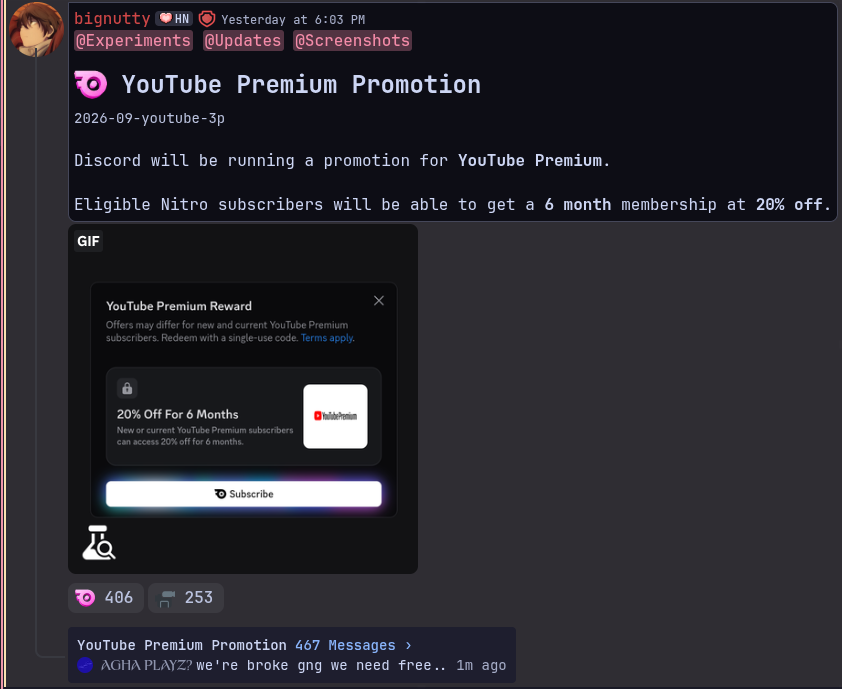
Gee, thanks Discord. A giant ad for YouTube Premium was actually not on my bingo card this year.
Fluxer is an alternative to Discord. It prides itself in being what Discord is, without the corporate bullshit. And while there is their equivalent of Nitro, the biggest reason its there to begin with is to fund the project, while also offering parity for those low-intelligence specimens that keep asking where nitro. Fluxer doesn’t pretend to be something you should invest in. They just want to be a chat platform. And the beauty of this project lies in its sourcecode. Which is open, available for anyone to use. You can even host your own version of Fluxer for your friends to use. If Discord goes, I’m moving to Fluxer. And if Fluxer goes, I’m making my own. That is the beauty of Free and Open Source. It gives power back to those who want it.
A lot of this isn’t Google.
I never said it was supposed to be, it is just one of many companies that I have issues with—De-Google is just the global term used for this kind of thing, and only because Google is the biggest offender, its literally everywhere. Your phone, Wristwatch, TV, Computer…But so are a lot of other things. Things I wanna get away from. Besides. De-Microsofting or De-Discording your life doesn’t have the same ring to it.
What else is there left to do?
When the time comes, I’m expecting to swap out Android on my phone for Linux, same with my Watch, same with my TV. There are a lot of devices in my house that I can switch off of big tech for more privacy, and honestly, I’m down to mess with it.
YouTube? Honestly a good question, and not something I can answer. In all Fairness, this one really depends on the creators on the platform. I would like to keep following them. But with no alternative to go to that offers the same tools for the same reach, they aren’t likely to move. So I’m just gonna have to deal with YouTube being a part of my life. I’ll still try though.
How can you do it too?
De-Googling is actually really easy, there is a chart of some sorts made for steps you can take here:
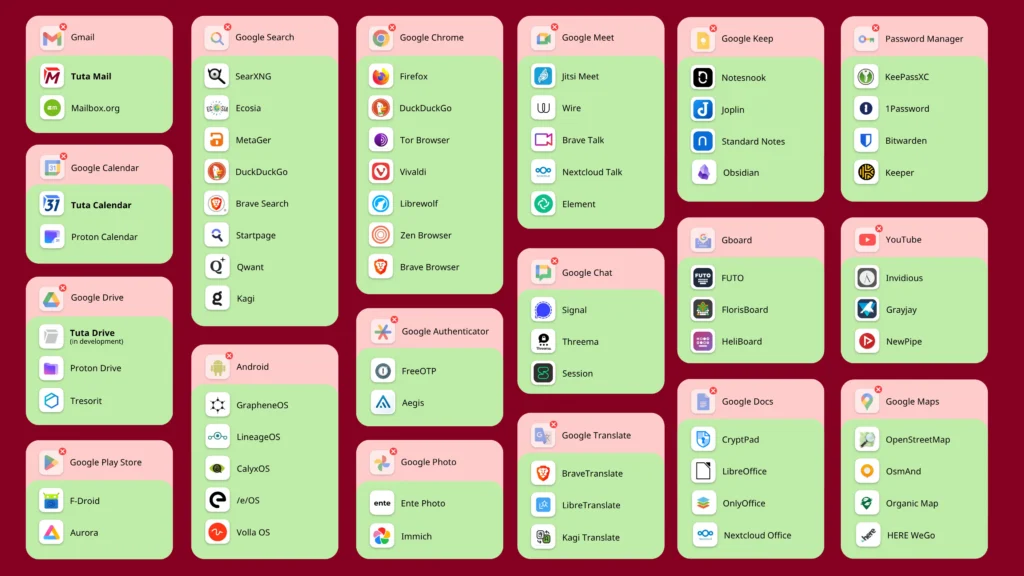
These are just a couple of options you have available to you for De-Googling.
Now if there is one important piece of advice I had to give anyone wanting to get into this, it would be to not rush in head first. You’re only gonna overwhelm yourself. Take Baby Steps. Switch one thing at a time, and take a month or two to adjust to the changes. Take it slow, and get comfortable before taking your next step. It is important you don’t take too much of a bite at once, lest you choke, and develop a disliking for the process. And if you don’t like doing it, you’ll have a harder time achieving your goals.
I’ll keep you lot updated if I make more developments.
That is all for now. Cya~
Comments.js